
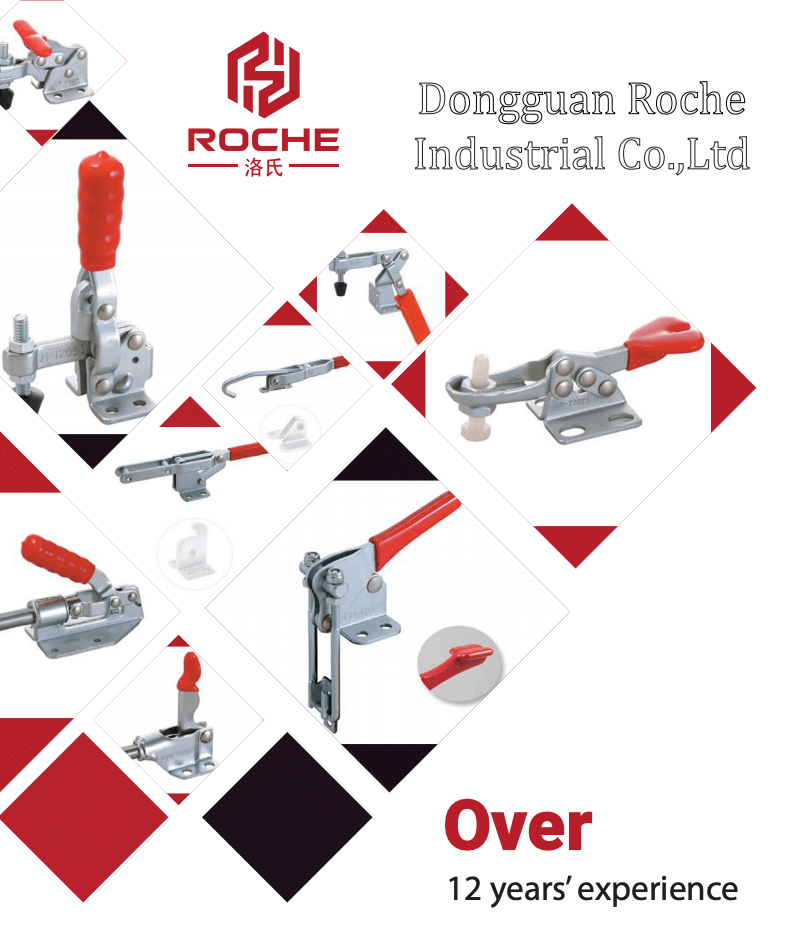
Vertical toggle clamps
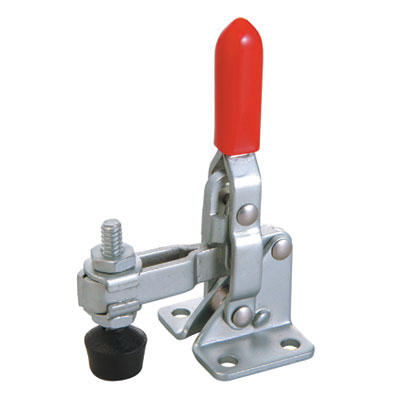
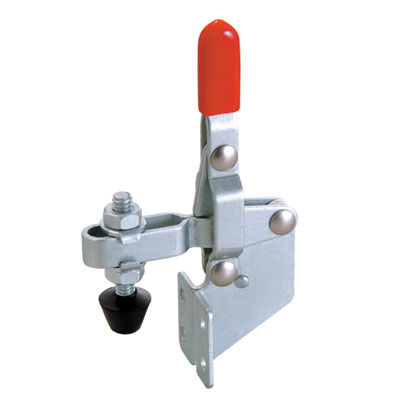
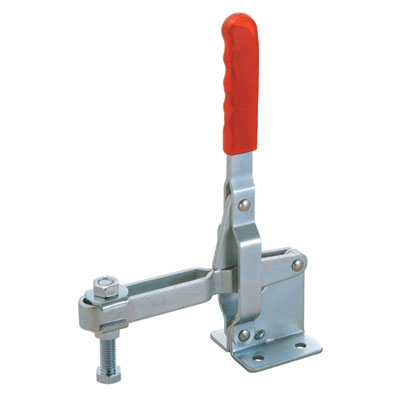
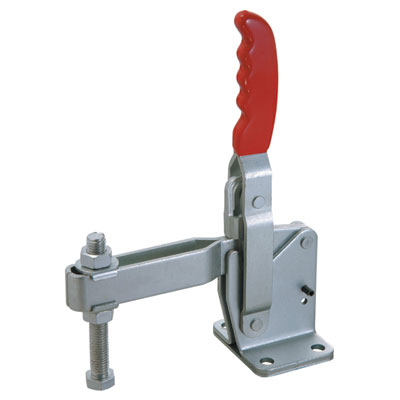
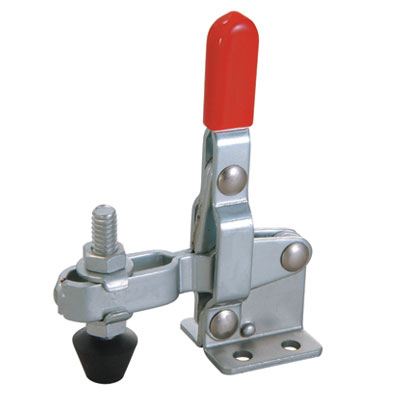
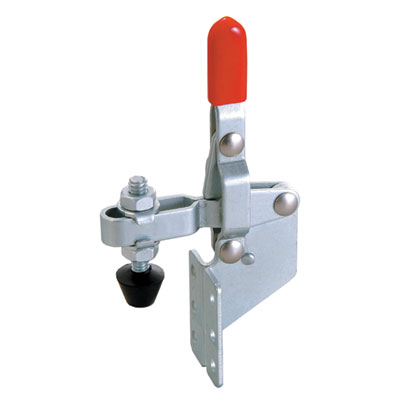
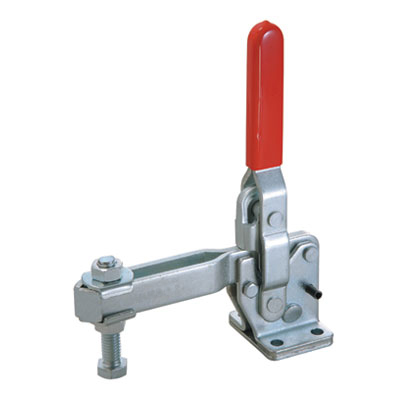
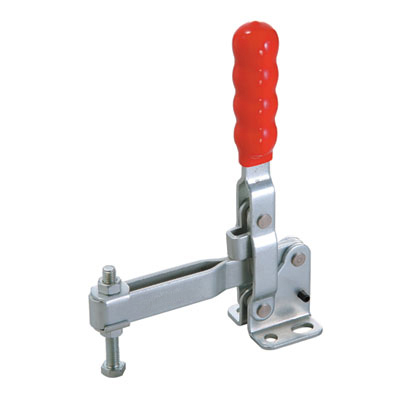
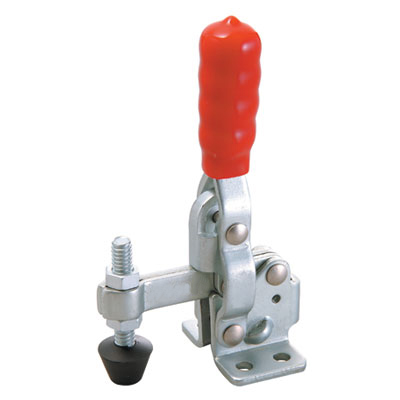
Vertical toggle clamps also called vertical handle toggle clamps or vertical hold-down toggle clamps. The names are identified by their vertical handles. These types of toggle clamps are capable of holding a huge amount of pressure.
Rocheclamp’s vertical handle clamps are manufactured with holding capacities of up to 22,00kN. The hold-down bar performances a minimum 90°opening angle loading and unloading easily and conveniently. The hold-down bar of vertical toggle clamps can be customizable. You can choose U shaped or solid. The base of the vertical hold down clamp also can be flange-mounted or straight.
Rocheclamp’s vertical handle toggle action clamps are also available in different material:steel plated zinc or stainless steel toggle clamp.
RocheClamp is a professional toggle clamps and accessories manufacturer in China, our clients are proud of our pull-down clamp’s quality.we are continually seeking new designs to fill needs that have not yet been met. Rocheclamp valued clients, with urgency and sincere interest in meeting your requirements. We persist driven to satisfy, driven to deliver a toggle clamp vertical product line that exceeds your expectations in price, quality, and delivery.
Please Contact Us And Tell Us How We Can Best Serve You!

CEO Notes
Hey! This is Robin, Roche Industrial Co.,Ltd Product CEO. Thanks to visit our website,and I hope to be a friend with you here. I have over 10 years experience in Handles,I would like to share my experience in this field,and any questions you have about toggle clamps ,I'm happy to help you. I provide free consultant for many clients,and if you need any help on toggle clamps,reach me any time with below button.
Helpful Resources To Know More About Toggle Clamps
Your Guide to Understanding the Use of Vertical Toggle Clamp
You are lucky to get this Vertical Toggle Clamp guide!
Understand what Vertical toggle clamp is, their types and their specific applications.
Workholding is often an ignored part of the machine or woodworking project.
Usually, workers put materials into some form of industrial tools for stability.
But, the right hold is absolutely essential for safety and precision.
Once materials slip during a process, there are more consequences than just having an off-specification product.
Ultimately, when workholding fails, it is uncommon for machines to become harmed.
It could then result in injuries to workers.
This is saddening, right?
This is why examining and knowing the diverse kinds of workholding tools is vital.
One essential type of workholding tools is the vertical toggle clamp.
Do you know a Vertical Toggle Clamp?
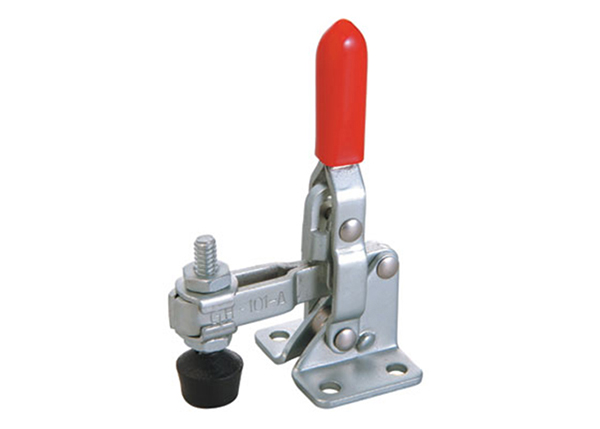
A vertical toggle clamp is a binding or clamping tool that normally consists of a handle, a holding bar, and a connecting system of levers and pivot pins to boost the applied pressure.
Once engaged, the clamp becomes locked.
This device normally serves to secure an object firmly to avoid it from separating or moving when an inward force is used.
Chapter 1: Amazing Uses of Vertical Toggle Clamp
Usually, vertical toggle clamps don’t get the same attention as opposed to two-jawed tools.
This is because the use of this tool is more specialized.
But, without this, you will struggle to find a way to address a clamping issue.
Having a vertical toggle clamp beside you, it can help you get away from hand strain.
You will also finish the job fast and safely.
Here are some of the vertical toggle clamp uses:
- Coping with Constricted Rails
One remarkable vertical toggle clamp uses are coping with constricted rails.
It is not safe to feed the constricted end grain of drawer door rails past a coping bit without supporting the object.
Without backing, the constricted rail can spin around.
This will ruin the cut and put your fingers in danger.
You can put a supporting board behind the constricted rail and grip the parts together without a clamp.
But you need to depend totally on hand strength for exactness.
Why take the stress if there is a device that can help you make the job easier?
Yes, it’s the Vertical Toggle Clamp!
- Cutting Tenons On-end
It is easy and fast to cut a tenon on a table saw using a standard knife or razor.
Standing with the workpiece on end and feeding it in the razor speeds the procedure.
It also makes tenons have flawless cheeks.
But, you cannot do it strongly freehand.
The object or workpiece can tip backward or forward and away from the fence.
It can bind the razor and lead to a kickback.
Instead, use a toggle clamp for fast cutting without compromising your safety.
- Template-routing Narrow Workwoods or Objects
A piloted outline bit and a template can assist you to turn out even arched door rails or all kinds of other shaped portions.
However, routing curved workpieces, most essentially if they are constricted can put your fingers severely close to the bit.
There is no need to take the risk.
You can use a vertical toggle clamp.
Just ensure the template piece is wider than necessary.
Once you own one, you will be surprised at how valuable and convenient a vertical toggle clamp can be.
The mounting convenience it offers, the size, and the considerable clamping pressure put them in a fixed position.
Chapter 2: How Does a Vertical Toggle Clamp Work?
A vertical toggle clamp is very important among the collection of work holding equipment.
However, how does a vertical toggle clamp work?
Are you interested to know more?
Read on:
This equipment works through a linkage technology of pivots and levers.
The fixed length levers, linked by pivoting pins, bring in the action and clamping power.
The toggle action has a lock point that makes a linkage and a fixed stop.
If in the lock state, the clamp doesn’t unlock except if the linkage is released or moved.
Even if it is oriented in many ways, a vertical toggle clamp is intended to utilize this basic idea.
A vertical toggle clamp is made so that the handle is upright when clamped about 90 degrees to the clamping arm.
Once released, both sway and hang towards the user.
The integrated stop pin can be released or moved between two positions or eliminated entirely.
This will allow you to choose three possible series of motion.
Chapter 3: Types of Vertical Toggle Clamps Available for Different Applications
There are many types of vertical toggle clamps available out there.
Each one has its own specific uses.
Knowing the various kinds of vertical toggle clamps available will help you determine which one is ideal for your specific work.
Check out your options:
Vertical Quick Release Toggle Clamps
This is a must-addition to jig assembly.
Roche is one of the leading providers of vertical quick release toggle clamps.
With its tough construction and efficient style, this tool makes sure that you obtain a firm hold on your workpiece.
It will give a grip that will not slip.
Some vertical quick release toggle clamps can hold a minimum 90-degree angle that allows you experience easy loading and unloading.
Some are integrated with colored grips for comfort and easy identification.
Some are also zinc plated to withstand corrosion.
Vertical quick release toggle clamps are handy and versatile tools that make woodworking perfection stress free.
Vertical Hold-Down Toggle Clamps
This type of toggle clamp is identified by its vertical handles.
Vertical hold down toggle clamps is made with holding capacities of 22.25kN or 5,000 pounds.
The clamping bar or also known as the hold-down bar exhibits a minimum 90-degree opening angle for fast loading and unloading.
This type of vertical toggle clamps can be U shaped or solid.
The bottom is straight or standard version.
Some vertical hold down toggle clamps out there can be obtained in stainless steel.
Some also come equipped with state of the art safety feature which adds a secondary lock to the clamp.
This assist ensures that the over-center locking condition is maintained.
This also ensures that locking is protected against the unwanted opening.
Some models available also lock the clamp in an open position.
A hold-down toggle clamp with flanged base and u-shaped bar comes with an upright hold- down handle for an array of clamping uses which include welding and machining.
The U-shaped clamping bar can be moved away from the bottom for a wider clearance angle.
Placing the holding screw near to the bottom allows for utmost holding capacity.
It has a maximum capacity of 1000 pounds.
It has 120 degrees maximum clamp bar opening.
The clamp comes with a toggle lock which maintains the pressure of the clamp and a flanged bottom for mounting to a work surface.
Some come with a plastic-covered handle for secure and stress-free grip.
Features to Look For in a Vertical Hold Down Toggle Clamp
There are many types of vertical hold down toggle clamp out there, which make it hard for you to choose from.
Make sure to consider these features when buying hold-down toggle clamp:
- A wide array of sizes and handle lengths
- Can be configured to meet the specs of the application
- Enable complete flexibility to position the handle, base as well as clamp arm
Vertical Toggle Clamp Pneumatic
This kind of toggle clamp utilizes the same basic style and operation as hold down clamps.
However, this is operated pneumatically.
This toggle clamp retains the enviable safety measure of the toggle lock, so, they keep mechanically locked even with a loss of air pressure.
Holding abilities are a function of the clamp/cylinder/pressure combination.
This is self-contained and just needs a pressure source to hook up.
A lot of styles are armed with a magnetic piston ring located at the end part.
Models of vertical pneumatic toggle clamps include retractor clamp, straight line toggle clamps as well as hold down clamp.
Three Distinctive Versions
This kind of clamp is available in three distinctive versions.:
- Vertically acting mechanism that shares the characteristics of the manual equivalent series from which they come from.
- Straight line action mechanism offers a push-pull result pressure. Swing action cylinder clamp is working on the principle of the helix.
- The obvious advantages provided by pneumatic toggle clamp which is air powered are the improved productivity and security.
Avoidance of accident handle opening although the supply of air is disconnected.
Features of Vertical Pneumatic Toggle Clamp
- This type of toggle clamp has a ductile cast iron base for rigidity and strength.
- Cylinder post is fitted with an air-flow restrictor to handle the speed of the cycle.
- A piston rod is integrated for safety against weld spatter
- A pivot point is fitted with stainless steel rivets to sustain accuracy and offer a long life.
- Magnetic piston allows sensing through the cylinder
How to Choose the Best Vertical Pneumatic Toggle Clamp
When it comes to choosing the best pneumatic toggle clamp, there are many things you have to consider.
Most especially, the safety feature and ease of use.
Ensure to choose a toggle clam which stays mechanically locked even with the loss of air pressure.
Ensure to consider the clamping force.
Buy one that has consistent clamping pressure.
Remote operation feature should also be considered.
A good pneumatic toggle clamp has a fast response time.
Where to Buy the Best Types of Vertical Toggle Clamp
Roche is the best place to buy any types of vertical toggle clamp.
All products are designed and made in China.
They only offer products from renowned and authorized dealers.
They conduct strong inspection and quality control during the manufacturing process.
You can visit their online store for more information.
Chapter 4: Vertical Toggle Clamp Mechanism Explained
A vertical toggle clamp is a plain mechanism that holds immediately.
It consists of clamping or holding arm to reach the workpiece, a handle to work, linkages for multiplying the used force, and a foot for mounting at the workstation on its base.
The handle is operated by means of moving the clamping arm to grip the workpiece.
A needed clamping power is obtained and exerted on the workpiece.
This holds the workpiece positively and firmly.
Action Power Factors of Toggle Clamp:
Holding Capacity
Toggle clamp holding capacity refers to the utmost strength or power.
The power allows the clamp to survive after being over-centered without causing harm to the clamp and without unlocking the toggle due to clamping distortion.
The over-center length is chosen carefully in relation to clamp elasticity to make the best of clamping power.
Clamping is maintained while making sure that the clamp lock closed even under intermittent loading.
For a vertical hold-down clamp:
Its clamping capacity is determined with the spindle at the utmost end of the clamping arm, and how far will it go up as the spindle goes closer to the holding arm.
Clamping Power
It is the level of power used to the workpiece by closing and locking the clamp.
In general, it is less than the affirmed holding capacity.
Definite clamping power depends on various factors like:
- proper spindle height adjustment
- the position of the spindle and the cushioning
- mechanical advantage of the clamps
- workpiece material
In most cases, about 1/3 of the affirmed holding capacity can be used by hand with less effort.
The Principle of Toggle
Toggle clamps work through a connecting system of pivots and levers.
The long stable lever is linked to pivot pins to bring in the clamping force.
Toggle action clamps have an over-center lock point that is a linkage and a fixed stop.
In over-center position, clamp can’t move or unlock except the linkage is moved.
3 Functions of the Vertical Toggle Mechanism in a Clamp
- To increase the applied load at the grip into a high clamping power to hold the workpiece.
- To make an over-center lock to avoid the clamp from releasing and opening the workpiece until opened by the user.
- To quickly open and close the clamp, providing an utmost clearance wherein to load and unload the workpiece.
Chapter 5: Why Choose Stainless Steel Vertical Toggle Clamp
Due to its bright, resistance to tarnish as well as silver finish nature, stainless steel vertical toggle clamp is one of the most reliable and durable types of toggle clamp.
A stainless steel vertical toggle clamp is extremely resistant to rust.
Stainless Steel Toggle Clamps are offered in all sizes and types and comes with amazing features such as:
- The hand grip is made of vinyl with padded rib profile for enhanced user comfort
- Linkage components and the body are made from high-quality stainless steel. Ideal for application within the pharmaceutical, food, as well as chemical industries.
- Stainless steel toggle clamps with adjustable spindle are made with a molded end that captivates the spindle, should it become loose while operating.
Chapter 6: Why Have A Durable Vertical Toggle Clamp?
In general, vertical toggle clamp is a very important tool to enhance your working experience.
It helps you to keep away from injuries due to unwanted slip.
Most of all it helps a lot in completing your job with accuracy and safety.
It offers lots of benefits such as save you time as the clamping and release are obtained in just a matter of seconds.
This provides remarkable time saving for every cycle.
It is also easy to incorporate.
No extra accurate machining or slotting needed while making use of this clamp.
A vertical toggle clamp is also versatile.
They are available in various types like hold down, pneumatic, quick release, push and pull, and many others.
Durability is also one of the benefits you can get from this tool.
All parts are tough, and zinc plated providing enough wear and corrosion resistance.
The material makes sure that it will have a longer working life.
It is also easy to maintain.
Occasionally a few drops of lubricating oil are needed to keep it in good working condition.
With this equipment, tooling cost is minimized as tool style, and tool making becomes easier.
Reduced cycle time minimized with low maintenance.
You can visit Roche for more information about vertical toggle clamp.
Roche is a premier source of high-quality clamps made in China.
All products are made of high-quality materials, yet the price is very reasonable.
Visit the website or contact customer hotline number.
Conclusion
Vertical toggle clamp is a must have for you.
Make sure to have one in your tools!
Yes, this can do so many things and can hold extreme pressure!
Make sure to have one that is durable and strong!
